

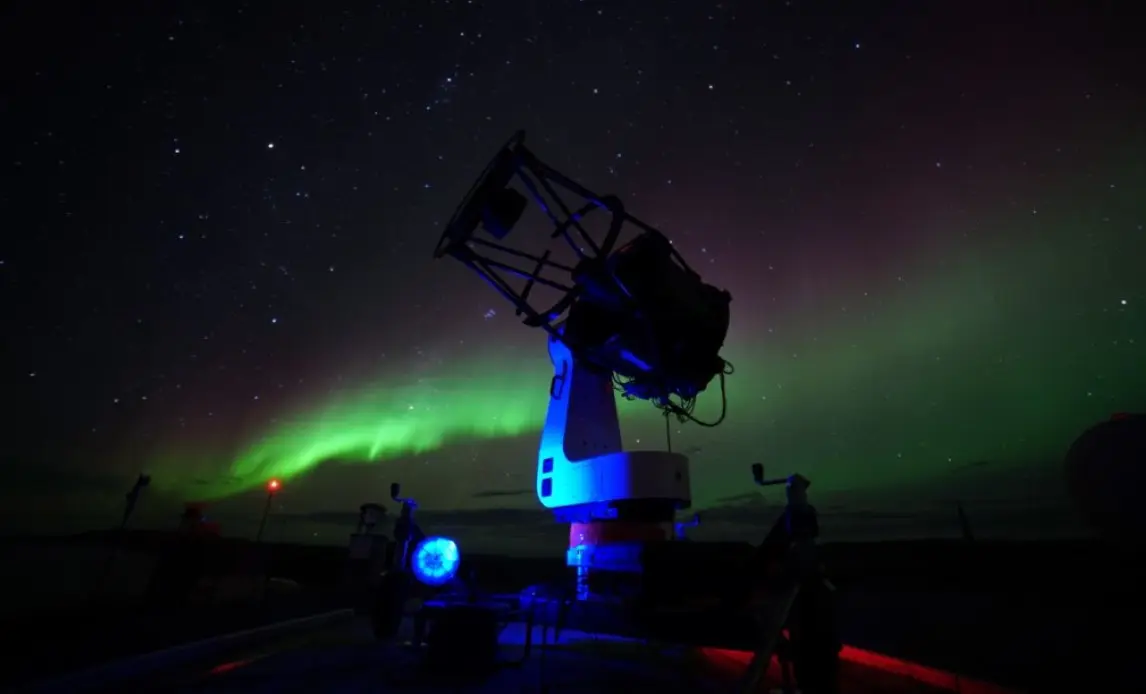
The Danish Defence Acquisition and Logistics Organisation (FMI) and DTU Space are currently testing a half-metre mirror telescope in Greenland. The project aims to evaluate the capability of optical sensors to track satellites over the Arctic, which could have direct implications for future military operations.
– It is a purely optical, passive telescope. It is simply about observing small objects in the sky, states the Danish Defence Acquisition and Logistics Organisation (FMI) in a press release.
A large number of satellites in polar orbits pass over the Arctic daily. Greenland is one of the few places in the world where these can be systematically observed from the ground, writes FMI. The agency is conducting the co-financed project DENASSI (Development and Evaluation of Necessary Arctic Space Safety Infrastructure) together with the research institution DTU Space.
Although DENASSI is fundamentally a civilian project, the evaluation has clear military relevance, according to FMI, which states that knowledge of satellite passages has become increasingly important for both land and sea operations. Experiences from the war in Ukraine show, among other things, that information on when optical or infrared sensors pass directly affects the timing of troop movements and logistics transports.
Denmark has previously participated in the EU's space surveillance cooperation (EU SST) alongside 15 other nations. The current project in Greenland will investigate what capabilities Denmark can realistically contribute from Arctic territory.
A comprehensive evaluation of technical solutions, operational forms, and costs will in the future form the basis for decisions. The Danish Defence Command is already involved, which means that the project may be operationally integrated into the Danish defence's future work within the space domain.